


Jewelry You Can Live In and Leave On: Why Rope Is the Only Material That Earns It
Most jewelry comes with invisible rules. Take it off before the gym. Remove it before the ocean. Don't shower in it. Store it when you sleep. The rules are so normalized that most women follow them without question. Jewelry you can live in, and leave on, is built on a different premise entirely: the piece stays. You live your life. Nothing changes.
I had little kids. I did not need one more thing to manage. I needed to put jewelry on and forget about it. I wanted something I could live in. Something I could leave on. Not because I was lazy about jewelry, because I loved it too much to keep taking it off.
I did not need to baby my jewelry. Nor did I want to.
That was the moment Tula Blue found its name for what it was making. Jewelry you can live in. Jewelry you can leave on. One phrase, two sides of the same truth.

Every Other Jewelry Brand Has Rules
Go find the care instructions for any jewelry brand you own right now. I will wait.
Sterling silver: remove before swimming, showering, exercising. Gold-plated: avoid salt water, chlorine, and prolonged sun exposure. PVD-coated stainless: safe for brief water contact, rinse after the pool, avoid hot tubs. Fine jewelry: store in a dry box, polish regularly, insure for travel.
Every single brand has rules. Not because they are poorly made. Because metal is metal. It reacts to water. It reacts to sweat. It reacts to chlorine and salt and the chemistry of your own skin on a warm day. The rules exist because the material demands them.
The rules are not a design flaw. They are an honest acknowledgment of what the material can and cannot do.
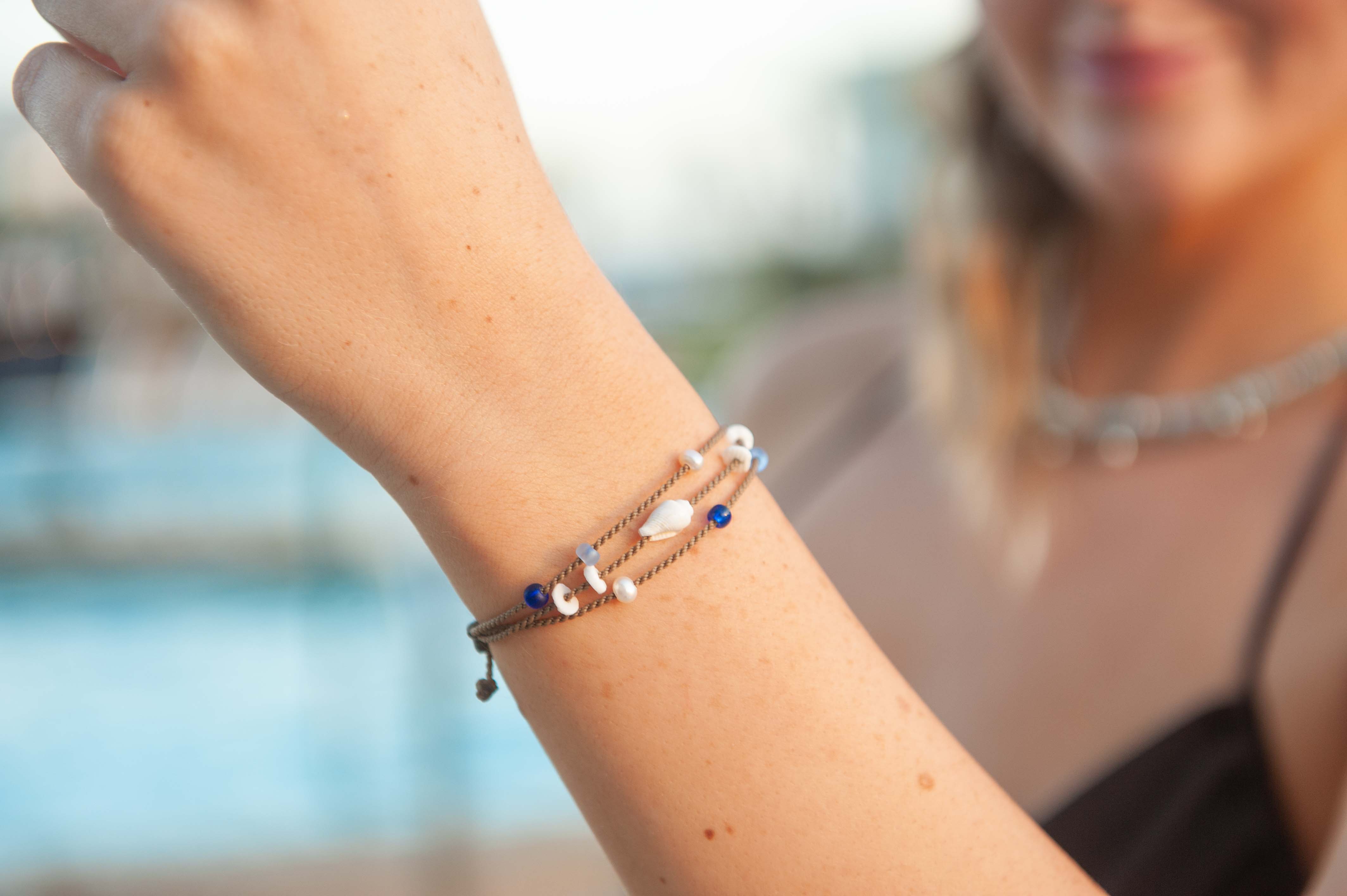
Tula Blue rope is not metal. It is nautical-grade whipping twine, the same material used to secure rigging on open-ocean sailboats. It does not corrode. It does not tarnish. It does not react to water, sweat, chlorine, salt, or the chemistry of your skin. It was engineered for sustained exposure to the harshest water environments on the planet.
So the rules do not apply. Not as a marketing claim. As a material fact.
There is no "avoid the pool." No "rinse after the ocean." No "remove before bed." No care instructions beyond: rinse in fresh water after a long beach day and let it dry. That's it. That's the whole list.

What "Jewelry You Can Live In" Actually Means
The phrase is not about convenience. It is about what happens to a woman's relationship with jewelry when she no longer has to think about it.
When jewelry requires management, it competes with everything else on her plate. She takes it off before the gym and forgets to put it back on. It sits on the bathroom counter for a week. She feels less like herself without it but does not have something durable enough to just leave on. The drawer full of jewelry she never wears is not a character flaw. It is the natural result of owning pieces that demand more than they give back.
Jewelry you can live in removes that friction entirely. She puts it on. She goes. The jewelry comes with her.
To the pool, the workout, the sauna, the ocean, the airport, the dinner, the sleep. One piece. Every day. Always on. Always there.
Sandra Wiesenfelder wrote about her Everyday Pearl Necklace: "I've been wearing the necklace continuously for several weeks, at work, while exercising, while sleeping...just always. It still looks like new." That is the sentence. She is not describing a durable product. She is describing a different relationship with jewelry entirely. One where the piece earns the right to stay.

What "Jewelry You Can Leave On" Means
"Jewelry you can leave on" is the same promise from a different angle.
"Live in" is about integration, the piece becomes part of who you are, inseparable from the life you are living. "Leave on" is about permission, you do not have to make the decision to remove it. Ever. Not before the hot yoga class. Not before the cold plunge. Not before you fall asleep. Not before the flight.
Most jewelry does not earn that permission. The moment you leave it on in the pool is the moment the coating starts to wear. The moment you sleep in a metal necklace is the moment the clasp digs into your neck. The moment you wear it in the ocean is the moment the salt starts the slow work of corrosion.
Rope earns the permission because there is nothing in it that responds to any of those conditions. The ocean does not corrode it. Chlorine does not degrade it. Sweat does not tarnish it. Sleep does not damage it. Heat does not expand a metal that can burn.
Leave it on. Not as an experiment. As the whole point.
Tula Blue customer Jennifer Romero said it better than most product descriptions ever have: "To me, uniform of accessories. Where style meets substance, and then politely asks if it can stay forever."
That is jewelry you can leave on. It asks to stay. And then it does.
Why We Crave Ease When Life Starts Moving Again
When routines pick up and plans expand, simplicity becomes valuable.
We naturally gravitate toward things that feel familiar and grounding. Wearing the same necklace or bracelet every day creates continuity—something steady as everything else shifts.
This is why everyday jewelry often becomes the most meaningful. It shows up for all of it: travel days, busy mornings, spontaneous plans, and quiet moments in between.
We explored this idea more deeply in our blog Jewelry That Speaks from the Heart: The Meaning Behind Every Piece, which looks at why the jewelry we repeat becomes emotionally significant over time.

Why Rope Is the Only Material That Earns Both
There are other brands making claims adjacent to this. Waterproof jewelry. Jewelry you can wear in the shower. Jewelry you never have to take off. Most of them are stainless steel with a PVD coating, a thin layer of gold applied in a vacuum chamber that holds up better than basic plating but is still, underneath, a metal with a coating over it. The coating degrades. The metal underneath is still there. The rules come back, eventually.

Rope has no coating. It has no metal underneath. There is nothing to degrade, corrode, tarnish, or react. The freshwater pearls and natural stones that finish each piece are set directly onto the rope, tied in place by hand. No metal prongs. No metal settings on most pieces. No clasp to break in the surf.
This is not a category of jewelry that existed before someone built it from a material that could actually support the promise. You cannot make jewelry you can live in out of gold-plated stainless steel and have it be true. You cannot make jewelry you can leave on out of waxed cord with metal closures and have it be true. The phrase requires the material. The material is the rope.

Handmade in Texas. Built for Your Life.
There's a reason Tula Blue jewelry is priced the way it is.
It's not mass-produced. It's not assembled overseas. Every piece is handmade in Texas by a team of nearly 20 women across our two workshops - one in the Corpus Christi area on the island, and one in Austin.
Our team members have real benefits. Health insurance. A 401k. Because we believe that making something beautiful shouldn't come at the expense of the people making it.
When you buy a piece of Tula Blue jewelry, you're not just buying something to wear. You're supporting real women doing skilled, physically demanding work - and you're getting something that reflects that care in every knot, every pearl, and every strand of hand-spun rope.
That's what handmade in the USA means to us.

The Stack That Never Comes Off
The pieces that earn the right to stay:
The Everyday Pearl Necklace, the most-worn piece in the Tula Blue line. Light enough to sleep in. Beautiful enough for dinner. Rope and pearl on your collarbone, every single day.
The Riptide Pearl Bracelet, the most reordered piece we make. The customers who find it describe the same thing: they put it on and stop thinking about it. That is not an accident. That is the rope doing its job.
The Everyday Pearl Anklet, because jewelry you can live in should be on every part of you that wants to wear it.
These are the pieces that the phrase was built around. The pieces that made "jewelry you can live in" feel like a description, not a slogan.
For the full guide to building a stack that never comes off, start with the ultimate summer jewelry guide. For why the material makes the promise possible, read the waterproof jewelry guide.

I Don't Put My Jewelry On in the Morning
I chose it once. With intention. And now it just lives with me.
Through the Pvolve workout. The walk with Willow. The work calls, and the school runs, the kids' activities, the dinners, and right back to sleep. It never comes off because it never needs to.
Right now I have 20 pieces on. Not kidding.
My necklaces have been on for six months. My anklets have been on for years. The only piece I take on and off is my Total Tula - the long metallic pearl necklace - because it's my statement piece. When it's on, I'm dressed up. Everything else stays.
Here's what I'm actually wearing right now.
Necklaces: A large Labradorite Gemstone pendant. An Everyday Pearl Necklace. A custom Watermelon Tourmaline necklace. The Crown Pearl Necklace adjustable in peacock. The Riptide Pearl Necklace is adjustable in peacock. And the Total Tula in metallic pearl - on and off, depending on the day.
Wrists: A Journey Pearl Bracelet. An Odyssey Pearl Necklace worn as a bracelet. A 14k gold-filled triple-stacked bracelet. My 2026 intention bracelet I made at the workshop with Apatite, Labradorite, Peacock Pearls, and Moonstone, to remind me of my focus this year. A chocolate Moonstone Everyday Stone bracelet. Another Crown Pearl Necklace wrapped around my wrist. And my one non-Tula piece - a Crucian Hook bracelet from Sonya's in St. Croix. I've worn this hook bracelet since I was a teenager, and a few years later, while I was living on St. John, meeting my now husband. I'm not giving that up. Some things are non-negotiable.
Anklets: Right foot has two - an Everyday Pearl Anklet in medium baroque peacock and a Riptide Pearl Anklet in white. Left foot has three - a Crown Pearl Anklet in peacock and two Classic Pearl Anklets.
Ears: Drop Pearl Earrings with gold hooks - I sleep in them (they are that comfortable! I swear, I am a psycho about my sleep, lol.) and switch between peacock Edison and metallic Edison pearls every two to three weeks.
Twenty pieces. Zero decisions every morning.

What Functional Jewelry Actually Means
Most people think functional jewelry means simple. Minimal. One delicate necklace that goes with everything.
That's one way to do it. It's a great way to do it.
But functional jewelry isn't about how many pieces you wear. It's about the decision you make once, and then stop making.
Functional jewelry is the stack you built intentionally and now live in completely. It moves through your whole day without asking anything of you. It doesn't need to be taken off for the workout, the shower, the flight, or the sleep. It just goes.
That's the freedom. Not the simplicity of fewer pieces. The simplicity of zero decisions.
I change my stack with the seasons - when I feel summer arriving, I'll shift to a large Larimar pendant and probably more blush pearls than peacock. When fall comes, I'll shift back. But once I make the change, it stays like that for months. One decision. Done.
Think about how much time that saves over the course of a year.

Why Less Jewelry Actually Means More
Building a jewelry wardrobe isn't about having less.
It's about choosing better.
When I stopped trying to have an option for every occasion and started investing in pieces that worked for all of them, everything got easier. I stopped losing earrings. I stopped having a drawer full of things I never wore. I stopped overthinking it.
I just put on my jewelry in the morning and got on with my life.That's what the right pieces do. They get out of your way. They show up for everything without asking you to think about them.
And that - more than any trend, more than any collection - is what a jewelry wardrobe is really for.

Ready to Find Yours?
The Jewelry You Can Live In collection and the Jewelry You Can Leave On collection are two ways into the same truth. Put it on. Leave it on. Live in it.





Leave a comment
This site is protected by hCaptcha and the hCaptcha Privacy Policy and Terms of Service apply.